

Passiflora caerulea
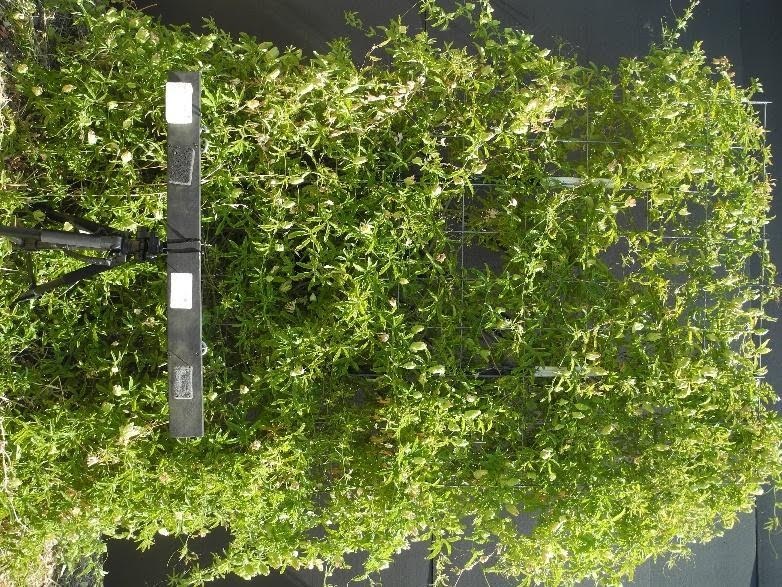
Passiflora caerulea at UC Davis in June 2025. Photo: JA Sisneroz
Summary
Native to South America, Passiflora caerulea, or the Blue Passionflower is an evergreen that can provide lush and dense canopy that is hardy in USDA zones 6-10. The Blue passion vine utilizes tendrils to latch onto structures allowing the vine to rapidly climb and fill in a space. The foliage is composed of dark green leaves that individually almost appear to be composed of multiple leaves that extend from a single central point. In the Spring, when lots of new growth is pushed out, this vine attracts the Gulf Fritillary Butterfly, a key pollinator, that has a dependence on this vine species specifically. As a result, their spiny black and orange caterpillars are a common sight. The most striking feature of this plant is its unique, complex alien-like flowers. These multilayered flowers are about 3-4 inches in diameter with the base consisting of white petals that form a gear-like shape. Layered above are the fine filaments that radiate outwards from the center like light beams from the sun. These filaments are multicolored with the outer half displaying a lavender-blue color, and the inner half remaining white creating a distinct bullseye pattern. Extruding up from the very center of the plant are the prominent reproductive structures of the flower, adding to the floral structure.
South Coast REC Results & Discussion
The Blue passion vine experienced high mortality, with more than half of the plants dying. Nearly all of the plants were ravaged by Gulf Fritillary caterpillars. Despite the lack of foliage due to defoliation by these caterpillars, many plants still bloomed and maintained bright, blue flowers with a radial shape and very distinct corona.
About 6 individuals across all treatments died during the establishment period, and of the remaining that went through the first 5 months of the deficit trial, foliage was frequently rated as unacceptable due to significant pest damage. By the end of 2024, about 3 more individuals died. Only 2 individuals were unaffected by the caterpillars and pushed out lush, relatively unharmed foliage, and covered nearly all of the trellis. Most of the plants, impacted by caterpillars or not, still bloomed and attracted many butterflies and bumblebees. However, most of the butterflies were from the Gulf Fritillary caterpillars. Going into 2025, many individuals began pushing out new growth, and for a couple of months, their foliage and overall appearance steadily increased. Then, during the 2025 Summer Open House, participants typically rated this taxon as just acceptable, except for the individual on the 80% treatment. However, just after the event, the caterpillars returned and consumed vast amounts of the passionflower’s leaves, leading to trellises covered in bare stems rather than lush foliage. By the time of the 2025 Fall Open House, participants rated these plants as unacceptable except for the individual on the 20% treatment, which was rated as visually impressive.
University of California Davis Results & Discussion
In our experience Blue Passionflower is one of those plants that is greater than the sum of its parts. This taxon is an example of why we at UC Davis implemented an Overall Appearance rating that is independent of the other categories rather than simply being a sum or mean of them. By the numbers researchers observed some amount of suspected pest damage on all plants during all months of 2025. This in turn weighed down foliage quality scores concurrently. However, we observed consistently high vigor scores, other than a few outliers, this plant was always growing during the trial period. New clean foliage was consistently being pushed out to cover older foliage. This plant was consistently in flower. While flowering scores were low, this was because we measure flowering abundance which assesses blooms as a percentage of plant canopy. However, everyday there were buds preparing to open, opening, or just senescing. We observed that the open flowers were popular with large carpenter bees, further adding interest. After carpenter bees and other pollinators visited, pollinated flowers would grow into orange colored fruits. Though not edible like other Passiflora sp., the fruits added visual interest - festooning the plants with orange baubles functioning as a foil for the purple flowers and green foliage. Put simply, there was always something going on with this plant, everyday it was slightly different - flowers coming in and out of bloom, the loud rumble of giant bees landing for a meal.
The Open House results suggest that some participants really liked this taxon while others did not. Their preferences appeared to be heavily influenced by how they weighted the foliage quality compared to the flowering. At both events 4-5 people remarked on the poor foliage quality. In the fall one participant put it best “leaves look great from a distance.” Many participants were so enamored with this plant and would overlook some foliage quality issues on otherwise healthy, vigorous plants. One participant noted “lots of blooms although none blooming,” reflecting that at our site blooms didn’t open until around 10-11 in the morning. Mid-day blooming notwithstanding, this taxon was one of the highest scoring at our Open Houses. In June, as a group Blue Passionflower was one of the highest groups of three, second only to Vitis ‘Roger’s Red’, while a hat was scored in September - the top three individuals were all Blue Passionflower. Furthermore 17 of 38 participants voted this taxon as their favorite vine in October. As a result, trying to characterize this plant in a summary is tough. Objectively these were vigorous plants with visible pest damage, subjectively these were vigorous plants full of interest - flowers, pollinators, and fruit. Blue Passionflower could be a great choice, as long as you know what aspects of plants you dislike, and which you value.
Basic Info
| Submitted by: | |
| Site(s): | UC Davis & SCREC |
| Trial Exposure: | Sun |
| Year evaluated: | 2025 |
| Height & Width after 2 years: | |
| Reported Height & Width at maturity: | |
| WUCOLS plant type: | V |
| Water Needs & WUCOLS Region: | Moderate - Region 2 Low - Region 3 |
| Mean Overall Appearance rating (1-5 Scale, 5 is highest) | UCD - 3.6 SCREC - 2.5 |
| Flowering Months: |
Growth and Quality Data
Click Here for Complete Data Set

The large, “flat” flowers of Passiflora caerulea were popular with bees, whether the flowers were open or not. Summer 2025, UC Davis. Photo: JA Sisneroz

Passiflora caerulea at UC Davis in May 2025. Photo: JA Sisneroz

Passiflora caerulea at SCREC in September 2025 covering the entirety of the trellis, showcasing vigorous growth, flowers, and fruit. Photo: N Lo

Passiflora caerulea at SCREC in June 2025 near the end of the deficit season showing unhealthy foliage and defoliation from caterpillars. Photo: N Lo

Parthenocissus quinquefolia at SCREC in October 2025 with healthy dense foliage turning redish-purple before dropping in the Fall. Photo: N Lo

Passiflora caerulea at UC Davis in July 2025. Photo: JA Sisneroz

Passiflora caerulea at UC Davis in August 2025. Photo: JA Sisneroz