

Parthenocissus quinquefolia
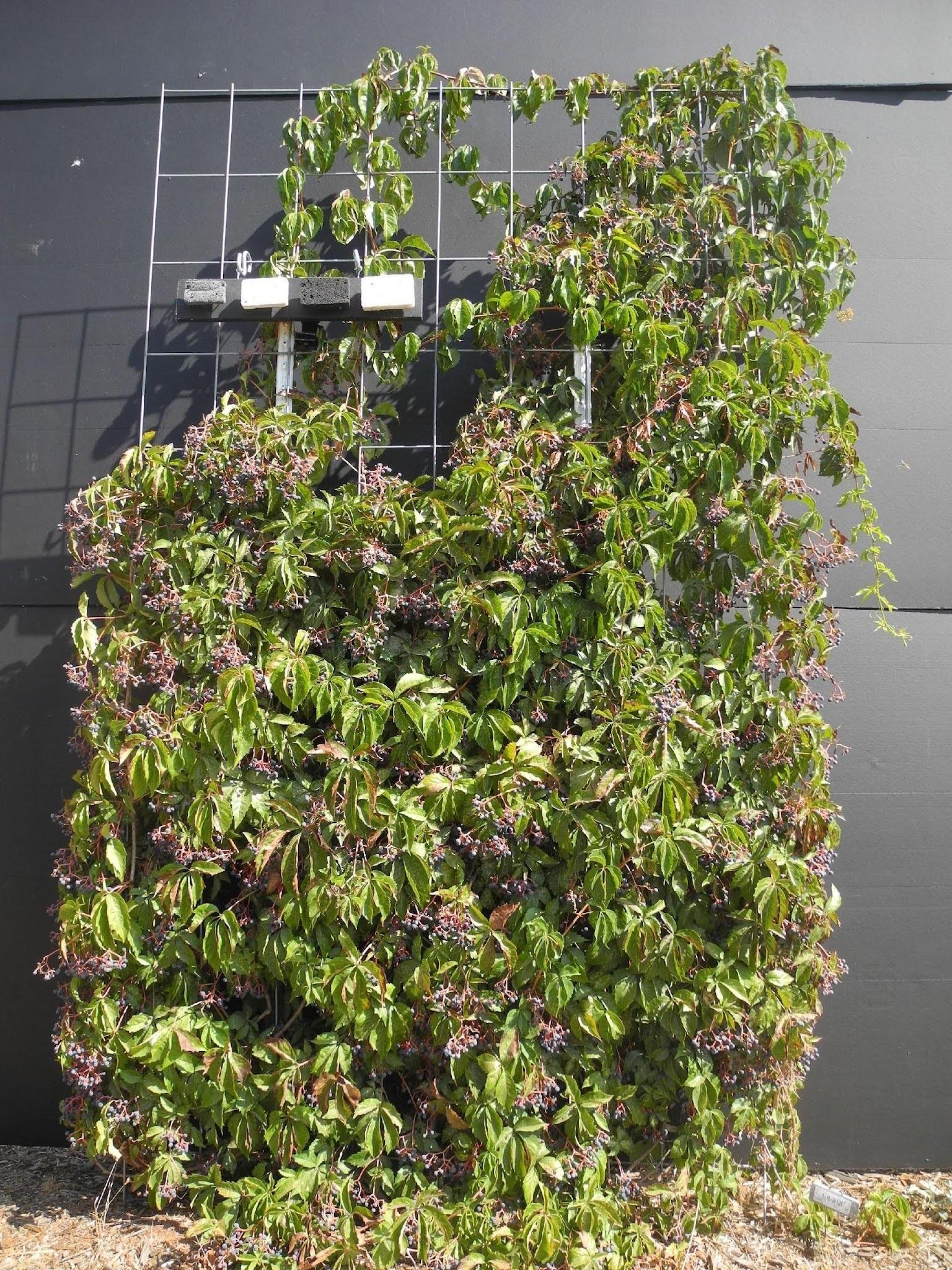
Parthenocissus quinquefolia at UC Davis in September 2025. Photo: JA Sisneroz
Summary
Parthenocissus quinquefolia (Virginia creeper) is a vigorous, deciduous vine in the grape family (Vitaceae), native to eastern and central North America, with a natural range extending from southern Canada through much of the United States. A fast-growing climber, it can reach 50–60 feet in height, sometimes putting on as much as 20 feet of growth in a single season, attaching itself to rough surfaces such as bark, rock, and masonry via tendrils tipped with small adhesive pads. Its leaves are alternate and palmately compound, each composed of five obovate leaflets with coarsely toothed margins and a glossy green upper surface, turning a striking crimson to purple in autumn. In late spring through summer, the plant produces small, inconspicuous greenish-white flowers roughly ¼ inch in diameter, which are insect-pollinated and give way to clusters of bluish-black berries that persist into early winter. Hardiness ratings vary across sources; most academic and extension references, including Utah State University Extension and the University of Wisconsin Horticulture Extension, list it as hardy in USDA zones 3–9, while commercial nurseries such as Monrovia cite zones 4–9, and the University of Florida IFAS Extension broadens the range further to zones 3B–10. These differences likely reflect variation between commercially conservative estimates and research-based assessments rather than any fundamental disagreement about the plant's cold tolerance.
Regardless of the precise zone range cited, Virginia creeper tolerates a wide range of conditions, including full sun, partial shade, heat, cold, drought (particularly in established plants), and even saline soils, making it a highly adaptable and resilient plant for the landscape.
South Coast REC Results & Discussion
The Virginia creeper performed exceptionally well across the majority of the plants throughout the trial, with zero mortalities observed. It featured large leaves consisting of five individual leaflets extending from a central petiole to create a dense and lush canopy. The vine demonstrated vigorous growth and successfully covered the entirety of the trellises. During its late spring blooming period, it produced minuscule bud-like flowers scattered across the plant, which eventually transitioned into an abundance of dark fruit. For the majority of the trial, the taxon remained pest and disease-resistant. However, some individual plants developed minor leaf spots towards the end of 2025, which could potentially be attributed to some sort of disease.
During the 2024 establishment period, the vines rapidly pushed new growth and quickly provided a solid wall of greenery. By 2025, this vine provided full and dense coverage. This performance was reflected in the 2025 Summer Open House, where participants gave the plant high overall appearance ratings. However, as a deciduous plant, its appearance changed significantly in the fall as the foliage turned red and leaves started to drop. This shift caused a split in feedback during the 2025 Fall Open House, where participants liked the Autumn colors but disliked the defoliation and bare branches. While it was rated lower in the fall due to defoliation, the plant was considered one of the top-performing taxa during this trial across all of the water treatments.
University of California Davis Results & Discussion
During the summer of 2024 researchers observed the stems of Virginia creeper tended to grow upwards 1-2 rungs of the trellis, then any new growth would hang off the trellis and grow downwards. As a result in February-March 2024, researchers wove these stems, which were quite flexible, upwards into the trellis. This noticeably increased coverage and this trait could be due to the natural habit of this species as a rambling plant. The plant pushed out a canopy of healthy green leaves in the spring and eventually flowered from late spring to mid-summer. The flowers are not very showy, however researchers observed they were very popular with honeybees. While collecting thermal data in the field, there was a consistent, audible hum from the quantity of bees visiting the flowers. Foliage quality, especially on the southern side of the trellis declined as the season progressed. Researchers observed sunburn and edge necrosis as frequent foliage issues. By September foliage quality was unacceptable for multiple individual plants, and some foliage had started to turn scarlet. At the same time the massive amount of flowers had progressed into large quantities of fruit. By September the berries had ripened, turning to a shade of dark blue and possessing a whitish coating.
At the June Open House, participants felt the plants were “acceptable” but several participants mentioned they were “not showy”. A few specifically remarked that they “loved the red stems” in reference to the red colored pedicels on clusters of fruit. Nearly 25% of the participants commented on the fruit in their written comments, with most viewing it positively - “ just love the look of this, covered w/ fruit.” At the September Open House roughly a similar portion noted that they loved the berries. While one person felt the appearance “was not helped by the berry clusters”, the berries acted as a point of interest and distracted from the foliage scores. Several participants noted the foliage looked “a bit dry with leaves curling a bit” and “they look like they are experiencing the start of fall.” Multiple participants also noted that the fruit might be good for wildlife - “I bet the birds love the berries.” The overall appearance ratings were high in June and had declined by September likely due to foliage quality concerns. Participants felt the overall appearance of an individual plant representing the 20% irrigation treatment had fallen below acceptability thresholds in September.
Basic Info
| Submitted by: | |
| Site(s): | UC Davis & SCREC |
| Trial Exposure: | Sun |
| Year evaluated: | 2025 |
| Height & Width after 2 years: | |
| Reported Height & Width at maturity: | |
| WUCOLS plant type: | Gc V |
| Water Needs & WUCOLS Region: | Low - Region 2 Low - Region 3 |
| Mean Overall Appearance rating (1-5 Scale, 5 is highest) | UCD - 3.2 SCREC - 4.1 |
| Flowering Months: |
Growth and Quality Data
Click Here for Complete Data Set

Parthenocissus quinquefolia at UC Davis in June 2025. Photo: JA Sisneroz

Parthenocissus quinquefolia at UC Davis in July 2025. Photo: JA Sisneroz

Parthenocissus quinquefolia at UC Davis in August 2025. Photo: JA Sisneroz

Photo 13a. Parthenocissus quinquefolia at SCREC in October 2025 with healthy dense foliage turning reddish-purple before dropping in the Fall. Photo: N Lo