

Gelsemium sempervirens
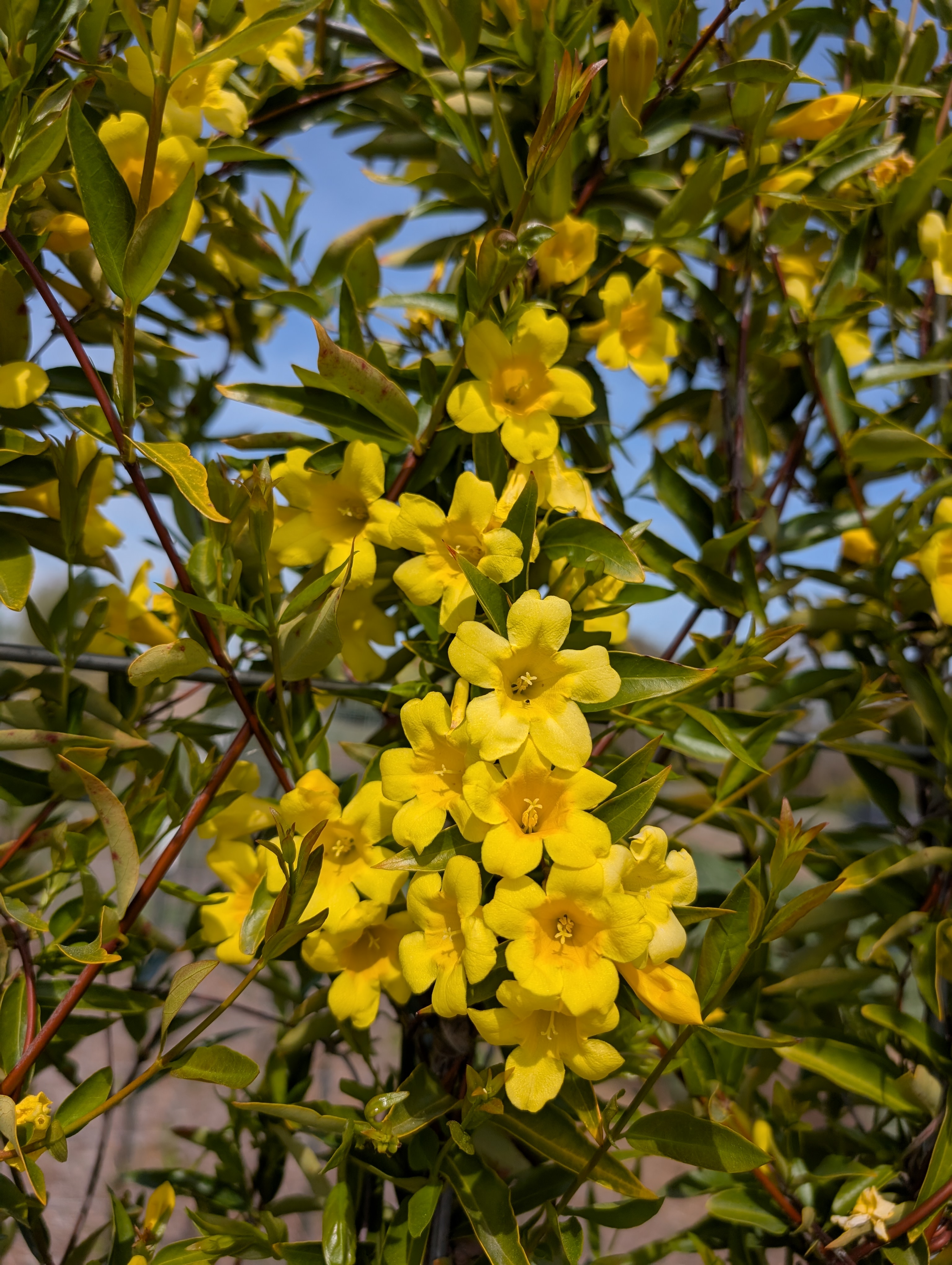
The yellow buds of Gelsemium just beginning to open in February 2026, with near peak bloom occurring in March 2026. Photo: J. Sizneros
Summary
Originating in the Americas, Gelsemium sempervirens grows in woodland habitats from Virginia to Florida, though eastern Texas and as far south as Guatemala. (Wildflower). This evergreen twining vine can grow in Sunset Zones 4 to 24 and USDA Zones 7 to 10. (Sunset, Missouri BG). Both Sunset Western Garden Book and the Missouri Botanical Garden notes this vine can spread to 20’. The lanceolate leaves have a glossy appearance. This plant flowers in late winter and early spring, producing cymes of fragrant trumpet shaped flowers. If the flowers are pollenated, small oblong fruits will form, initially green and fading to brown over time. Several sources report that the pollen from Carolina jessamine is toxic to honeybees.
South Coast REC Results & Discussion
The Carolina jessamine performed acceptably throughout the trial with minimal outliers. It had characteristically short, narrow leaves that grew close together along the branches, typically forming a bush around the base of the vine. Many individuals of this taxon covered nearly all of the trellis by the end of the trial with various degrees of leaf tip burn.
Throughout the first year of the trial, most individuals had some chewing insect damage, but it was not significant. They did not bloom, but they did rapidly push growth and sprawl across the trellis. Light maintenance was needed to keep some of the branches from hanging off the trellis. Going into 2025, their foliage significantly improved, with much less damage from pests and diseases. They continued to push their growth and had a bright but short-lived blooming season. Small, yellow flowers covered the entirety of these vines, practically creating a wall of bright, delicate yellow. However, by the time the 2025 Summer Open House came around, most of the flowers had fallen away. Participants in this Open House still rated these vines as aesthetically pleasing and impressive. Throughout the rest of the year, foliage and overall appearance steadily declined as the leaves slowly yellowed. Most individuals maintained their coverage of the trellis, but a few did defoliate. This decline was reflected in lower ratings in the 2025 Fall Open House, but overall, the vines remained acceptable.
University of California Davis Results & Discussion
In 2025 Carolina jessamine flowered from February to March at UC Davis, though data was not collected as it was outside of the flowering period. During the establishment period trials staff did some initial weaving to ensure shoots were evenly distributed across the base of the trellis. Subsequently, little maintenance was needed other than occasional weaving to minimize lopsided coverage or fill in any holes. During the winter the foliage took on a lighter, chartreuse coloration, with deeper green coloration appearing with the onset of spring. Participants at the June Open House noted that the plants looked healthy with several people noting that they enjoyed the red coloration on the new stems.
As the season progressed, some of the foliage appeared to yellow or bleach out during August and September. We think this was in response to the temperature. At our September Open House, participants’ ratings were mixed with the mean overall appearance ratings for the 50% and 20% individuals scoring 4 or above, while the 80% had a mean rating of 2.9. The individual plant on the 80% treatment was noticeably more yellow, with participants writing that the plant looked chlorotic. This does not seem to be a treatment effect as yellowing was observed on all three treatments, rather the plants including the Open House were initially selected in the spring and were re-used for continuity. The plant participants rated, 11-15, moved down in quality as the season progressed and ended up as one of the two lowest scoring individuals for the 80% treatment. To sum up the performance, Carolina jessamine is not the showiest plant, however it does perform reliably on lower irrigation maintaining acceptable to above average aesthetic appeal and serves as a harbinger of spring with its early bloom.
Basic Info
| Submitted by: | |
| Site(s): | UC Davis & SCREC |
| Trial Exposure: | Sun |
| Year evaluated: | 2025 |
| Height & Width after 2 years: | |
| Reported Height & Width at maturity: | 12-20 ft |
| WUCOLS plant type: | V |
| Water Needs & WUCOLS Region: | Low - Region 1 Low - Region 2 |
| Mean Overall Appearance rating (1-5 Scale, 5 is highest) | UCD - 3.4 SCREC - 4 |
| Flowering Months: | Feb.- Mar. |
Growth and Quality Data
Click Here for Complete Data Set

Gelsemium sempervirens at UC Davis in May 2025. Photo: JA Sisneroz

Gelsemium sempervirens at SCREC in October 2025 displaying yellowing leaves that were frequently observed from this species. Photo: N Lo

Gelsemium sempervirens at UC Davis in June 2025. Photo: JA Sisneroz

Gelsemium sempervirens at UC Davis in July 2025. Photo: JA Sisneroz

Gelsemium sempervirens at UC Davis in August 2025. Photo: JA Sisneroz